Trucking and freight
The load is delivered. The money is 30 to 45 days out.
Fuel went on the card at the pump. The insurance premium, the tolls, the trailer repair, and the driver's settlement all landed this week. The broker pays on its own terms. Dicopay sends the invoice for free, chases it for you, and checks it for a financing offer from independent regulated lending partners.
Invoicing and reminders are free, always. Checking what an invoice is worth costs nothing. You only pay if you take the cash.
Dicopay's invoicing app is live in Sweden today. Financing availability, pricing, and partners vary by country.
How freight actually pays
Your costs run on the load. Your revenue runs on their calendar.
Every step below is normal. None of it is a dispute, a bad broker, or a mistake on your side. It is simply how the money moves in this trade.
You book the load
The rate confirmation from the broker sets the rate, the pickup, the delivery, and the payment terms. The terms are usually already written when you sign it.
You run it, and you pay for it first
Diesel is bought before the wheels turn. Tolls post within hours. The driver expects settlement on the usual cycle whether or not the broker has paid you.
You deliver, then you send the paperwork
The packet is the signed bill of lading, the proof of delivery, any lumper or detention receipts, and the invoice referencing the load number. Most brokers start counting the terms from the day a clean packet reaches them, not from the day you unloaded.
Accounts payable pays on terms
Net 30 is the common default and net 45 is not unusual. Quick pay exists at most brokers, and it costs you a slice of the linehaul to get your own money early.
The next load starts before that one pays
You are already paying for fuel on three more runs, the insurance installment, the truck payment, the quarterly fuel tax filing, and a tire that did not last. None of it waits for the broker's payment run.
Illustrative example
You deliver on Tuesday the 3rd and the packet clears on Thursday the 5th. On net 30, the broker's payment run reaches you in the first week of the following month. In that window you buy fuel for three more loads, pay one insurance installment, and settle the driver twice.
37 to 38 days
A US invoice takes 28.8 to 29.3 days of payment terms plus 8.5 to 9 days of lateness, so 37 to 38 days in total.
Dicopay calculation from Xero Small Business Insights US, 2026
43%
43% of US B2B invoice value is overdue at any given time.
Atradius Payment Practices Barometer US, September 2025
The paperwork
What a broker invoice is.
A freight invoice is rarely one page. It is a packet, and the packet is what the broker's accounts payable team pays against.
The rate confirmation
The broker's written agreement for that load. It carries the load number, the agreed rate, any accessorial charges, and the payment terms. Your invoice has to match it line for line, or it can come straight back to you.
The proof that it moved
The signed bill of lading and the proof of delivery show the load was picked up and dropped. Lumper receipts, detention, and layover are billed on top and each one needs its own document.
The invoice and the clock
The invoice is issued to the broker, so the broker is your customer, even though it is the shipper's freight. A missing signature or a wrong load number restarts the clock, which is why a rejected packet costs a week.
Who owes you matters more than who hauled it.
On a financing offer, the funding partner looks at the invoice and at the business that owes the money. In freight that is the broker or the shipper on the invoice, not the shipper further up the chain. Financing applies to invoices you issue to another business or a public body, which covers most freight work. Eligibility, pricing, and terms are set by the funding partner and disclosed to you before you accept.
Factoring in freight
Why factoring is common in this trade, and where an advance differs.
Factoring has been part of trucking for a long time, and the reason is plain. The gap between paying for a load and getting paid for it runs weeks, it repeats with every load, and bank credit sized for a one-truck or two-truck operation is hard to arrange. Factoring solved the timing. It also came with a contract.
| What you are agreeing to | A traditional freight factor | An invoice advance through Dicopay |
|---|---|---|
| The commitment | You sign an agreement with a term, often a year, and it carries a notice period to get out of it and sometimes a monthly minimum volume you have to keep feeding. | There is no long-term contract and no minimum. You decide one invoice at a time, and deciding nothing costs nothing. |
| How much you have to put through it | Whole-ledger and all-or-nothing schedules are common. Once a customer is assigned, every load for that customer goes through the factor, at the factor's price. | There is no all-or-nothing schedule. You can finance one load, finance none, or finance the one that covers next week's fuel and leave the rest alone. |
| Where the broker sends the money | The broker pays into a lockbox or an account the factor controls. Your customer is told to send the money somewhere new, and your remittances reach you through the factor. | There is no lockbox. Your customer gets the same invoice, the same due date, and the same payment instructions as always. |
| What it costs | You pay a discount rate plus fees for wires, fuel cards, and credit checks, and a reserve is often held back until the broker pays. | Priced per invoice. It is a single fee on the invoice value, quoted by the funding partner and shown to you before you accept. |
| Who carries the risk if the broker never pays | The master agreement you signed at the start decides whether it is recourse or non-recourse. | The individual offer says whether it is recourse or non-recourse, and you read that before you accept it. |
| Who is actually lending | The factor buys your receivable and holds the relationship with you. | Independent regulated lending partners fund the advance. Dicopay is not a lender and does not fund invoices. |
Swipe the table sideways to see every column.
Factoring terms vary between providers. Read your own agreement, and compare it against the offer in front of you.
What you get
Free invoicing first. The cash offer is optional.
Invoicing is free with no monthly fee and no card. Contracts, e-signature, and time reporting are included. Automatic payment reminders go out before the due date and after it, from Dicopay on your behalf, so you are not the one emailing a broker's accounts payable desk at 10 p.m.
Your customer opens the invoice on their phone and pays in full, on invoice up to 60 days, or in installments. They do not need an account. Every invoice you issue to another business or a public body is checked for a financing offer. If you take one, your customer approves on their phone and the money is in your account within 24 hours.
This is the same product every Dicopay customer uses. There is no separate freight edition and no trucking-only pricing.
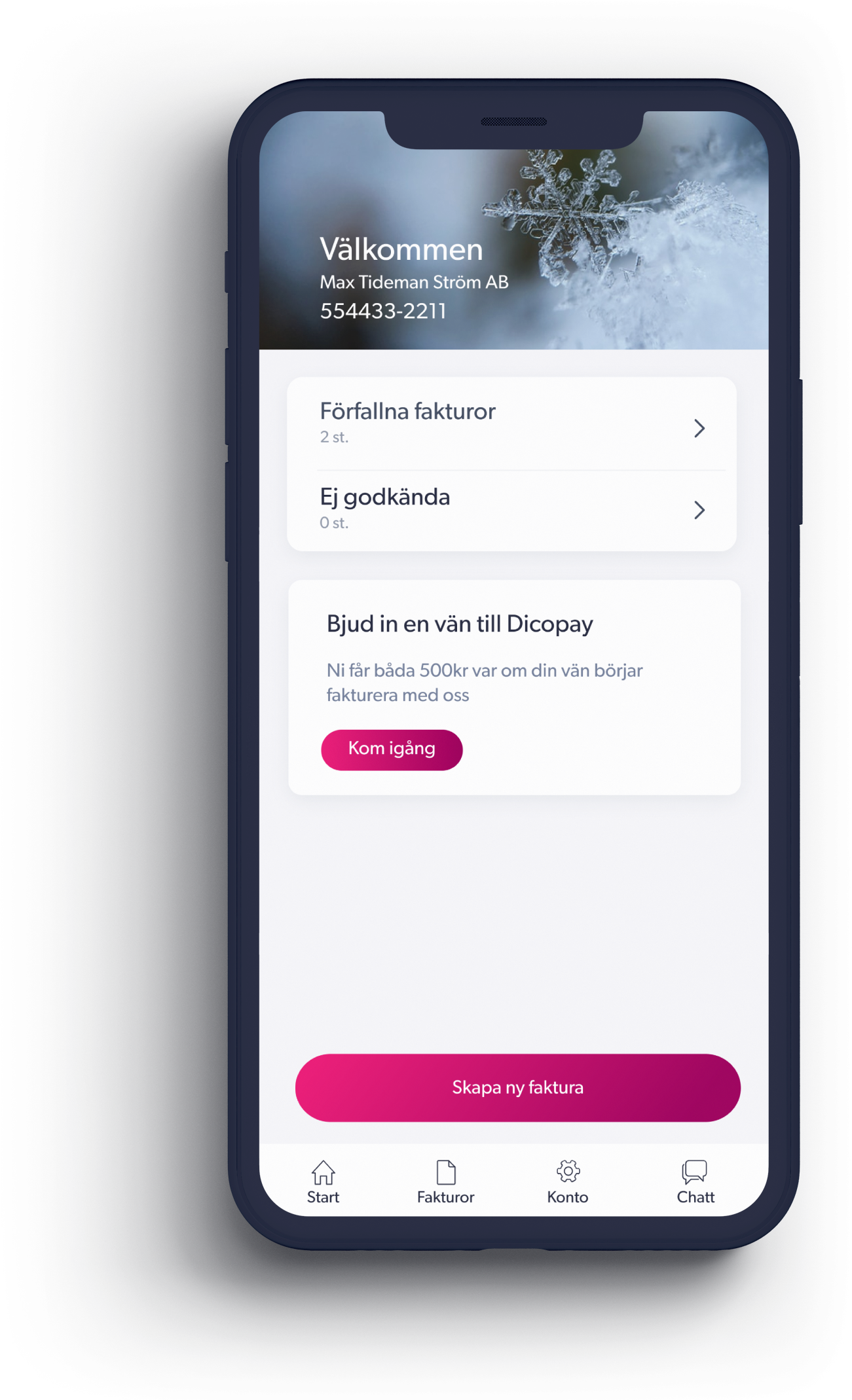
Dicopay is not a lender.
Financing is provided by independent regulated lending partners. They decide eligibility, they set the pricing, and they write the terms, and all of it is disclosed to you before you accept anything. Dicopay is paid a referral fee by the partner when a deal funds, which is how the invoicing stays free. Offers are subject to approval and not every invoice qualifies.
FAQ
Questions from the cab and the office.
Do I have to put every load through this?
No. There is no schedule to fill and no minimum volume. You can send every invoice through Dicopay for free and take an advance on none of them, or on one load in a slow week. Plenty of businesses use Dicopay purely for free invoicing and reminders and never take an advance.
Will my broker be told to pay somewhere new?
No. Your customer receives the same invoice, on the same terms, with the same due date. There are no new payment instructions, no new bank details, and no lockbox. The only change they notice is that payment reminders come from Dicopay on your behalf rather than from you.
What happens if the broker never pays?
That is written on the offer before you accept it, not after. Under a recourse arrangement, if your customer does not pay, you repay the advance. Where an offer is non-recourse, the funding partner carries that risk instead. You see which one applies, along with the price and the terms, before you agree to anything.
Which of my invoices can be financed?
Financing applies to invoices issued to another business or a public body, so broker and shipper invoices are the relevant ones. Eligibility and pricing are set by the funding partner, and not every invoice qualifies. Invoices to consumers can still be sent and chased for free.
Easy invoicing, fast cash.
Invoice the load for free and see what it is worth today. If the number is not worth it, close the tab. You keep the free invoicing and somebody else chasing the broker.
Start invoicing for free No card. No subscription. No long-term contract. No obligation to accept an offer.