Solar and energy
You buy the system months before the last payment lands.
Panels, inverters, racking, and crew hours are paid for long before an inspector signs off and the balance clears. Dicopay sends your invoices for free, chases them for you, and checks every business invoice for a financing offer from independent regulated lending partners.
Invoicing and reminders are free, always. Checking what an invoice is worth costs nothing. You only pay if you take the cash.
Dicopay's invoicing app is live in Sweden today. Financing availability, pricing, and partners vary by country.
The problem
The equipment invoice arrives first. Yours arrives last.
A residential array is bought, racked, wired, and energized on your money. The distributor wants to be paid on its terms, the crew is paid every week, and your final invoice cannot go out until somebody else has been to the roof with a clipboard.
One 12 kW residential job, from purchase order to sign-off.
Illustrative example
Paid out before sign-off
$11,050
You carry this much on this job alone.
Received by that point
Now run four of these at once. The gap is the size of your whole month, not a rounding error in it.
The equipment is bought on your credit
Distributors want a deposit or payment on short terms, and a container of panels does not wait for the homeowner's lender to fund. You are financing the hardware for every job on your books at the same time.
Milestones are somebody else's calendar
Progress payments are tied to permit approval, install completion, inspection, and utility permission to operate. Every one of those dates is set by an office you do not work for, and a failed inspection moves all of them.
The final payment is the biggest one
The balance you are still owed after commissioning is usually the largest slice of the contract, and it is the slice that arrives last. Payroll, the truck payment, and the next equipment order all land before it.
The wait, measured
Nobody is disputing your invoice. It is just sitting there.
These are the US numbers for small businesses generally. Solar sits at the slow end of them, because the invoice cannot even go out until the paperwork clears.
$17,500
The average US small business with invoices outstanding is owed $17,500.
Intuit QuickBooks Small Business Late Payments Report, May 2025
37 to 38 days
A US invoice takes 28.8 to 29.3 days of payment terms plus 8.5 to 9 days of lateness, so 37 to 38 days in total.
Dicopay calculation from Xero Small Business Insights US, 2026
22%
22% of US small employer firms that applied for financing received none of it, and only 42% received everything they asked for.
Federal Reserve Small Business Credit Survey, 2026
43%
43% of US B2B invoice value is overdue at any given time.
Atradius Payment Practices Barometer US, September 2025
What an advance does
The next job stops waiting on the last one.
An invoice advance is money you have already earned, paid to you early. On a job pipeline that changes one specific thing: the equipment order for job four is no longer held up by the check for job one.
You invoice the milestone the day it clears
Deposit, install completion, or final balance after sign-off. Whatever your contract lets you bill, you bill it from your phone on the roof rather than from the kitchen table on Sunday night.
The invoice is checked for an offer
Every invoice you issue to another business or a public body is checked for a financing offer from independent regulated lending partners. Milestone billing means several invoices on one job, and each one is checked on its own.
You take the cash, or you leave it
If you accept, your customer approves on their phone and the money is in your account within 24 hours. If the number is not worth it, you decline and the invoice carries on being chased for free.
The panel order goes in this week
You order for the next install on the strength of work you have already finished, instead of pausing the crew until an accounts payable department runs its monthly cycle.
Dicopay is not a lender.
Financing is provided by independent regulated lending partners. They decide eligibility, they set the pricing, and they write the terms, and all of it is disclosed to you before you accept anything. Dicopay is paid a referral fee by the partner when a deal funds, which is how the invoicing stays free.
Offers are subject to approval and not every invoice qualifies. Pricing on the financing side is per invoice, quoted by the funding partner before you agree to it. Checking costs nothing and declining costs nothing.
The invoicing side
Built for jobs that get billed in pieces.
Invoicing is free with no monthly fee and no card. Contracts, e-signature, and time reporting are included, so the signed scope, the crew hours, and the invoice for each milestone all sit in one place.
Reminders go out before the due date and after it, from Dicopay on your behalf. You stop being the person emailing a homeowner about the balance while you are trying to sell them a battery.
Your customer opens the invoice on their phone and pays in full, on invoice up to 60 days, or in installments. They do not need an account, a password, or an app.
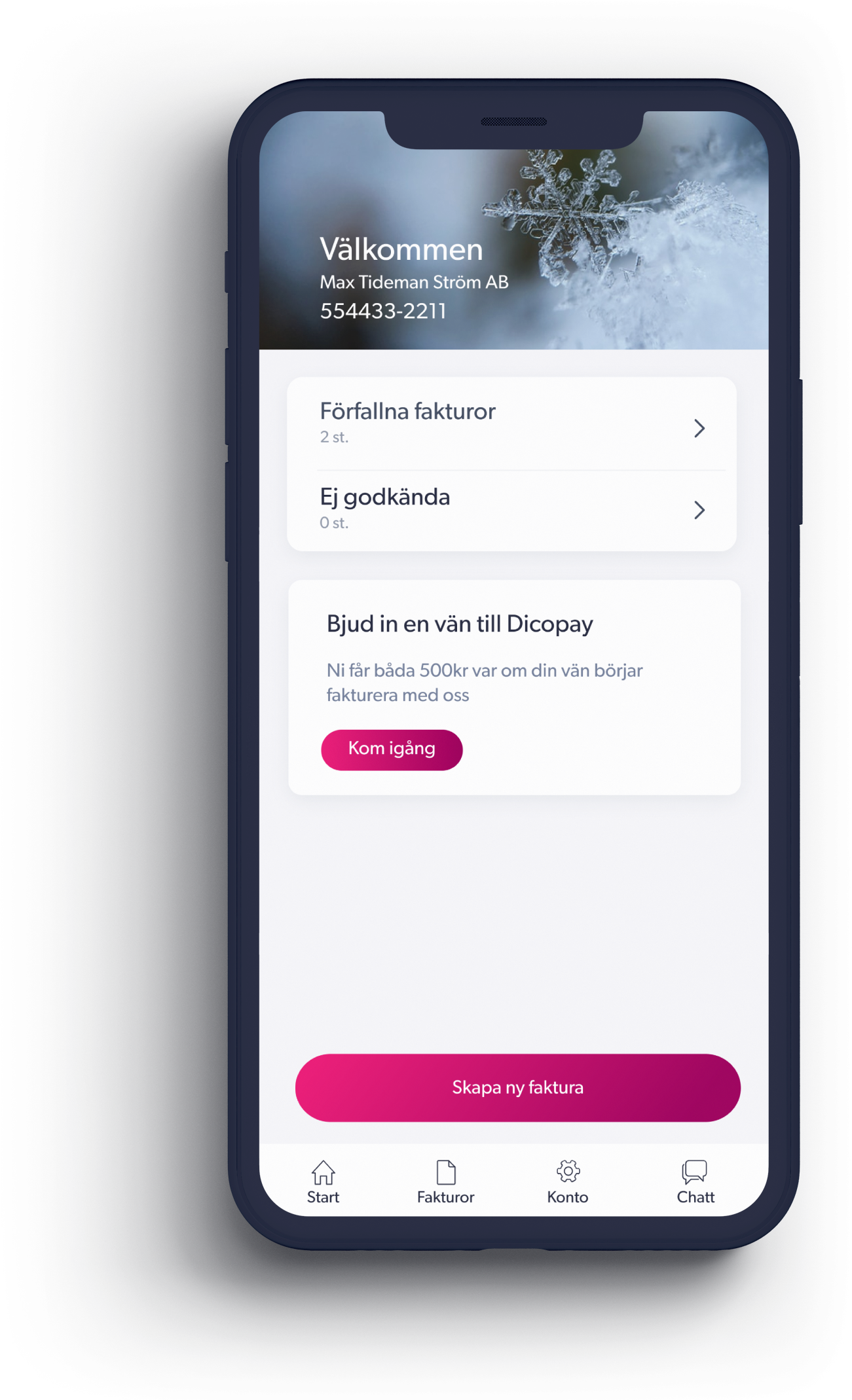
Commercial and subcontract work
Invoices to a builder, a developer, a property management company, an EPC you subcontract for, or a municipality are the ones checked for a financing offer. Those are also the invoices with the longest terms.
Homeowner work
An invoice to a private homeowner is a consumer invoice, so financing does not apply to it. You can still send it, split it into installments, and let Dicopay chase it, all for free.
FAQ
Questions solar installers ask.
My customer is a homeowner. Does that invoice qualify?
No. Financing applies to invoices issued to another business or a public body, so a private homeowner's invoice is outside it. That invoice is still sent for free, can still be paid in full, on invoice up to 60 days, or in installments, and Dicopay still sends the reminders. If you subcontract for a builder, a developer, a property manager, or a public body, those are the invoices that get checked for an offer.
Can I get an advance before the system is signed off?
An advance is against an invoice you have already issued, so you can only ask for one once your contract lets you bill. If your contract has a deposit stage and an install stage, those are separate invoices and each is checked for an offer on its own. Nothing is checked against work you have not yet invoiced.
What happens if the inspection fails and my customer withholds payment?
What happens if your customer does not pay is written on the offer before you accept it, not after. Under a recourse arrangement, if your customer does not pay, you repay the advance. Where an offer is non-recourse, the funding partner carries that risk instead. You see which one applies before you accept, and the terms are set by the funding partner.
Will my customer know I financed the invoice?
They receive the same invoice, on the same terms, with the same due date. There are no new payment instructions, no new bank details, and no debt collector. The only difference they notice is that reminders come from Dicopay on your behalf rather than from you.
Easy invoicing, fast cash.
Bill the milestone the day it clears, and see what that invoice is worth today. If the number is not worth it, close the tab and keep the free invoicing and the reminders.
Start invoicing for free No card. No subscription. No obligation to accept an offer.