Construction
You carry the job. The money moves on someone else's cycle.
Payroll runs every week. The supply house bills on its own terms. Your pay application goes in once a month, waits on the general contractor and the owner, and a slice of it is held back until closeout. Dicopay sends your invoices for free, chases them for you, and checks every business invoice for a financing offer from independent regulated lending partners.
Invoicing and reminders are free, always. Checking what an invoice is worth costs nothing. You only pay if you take the cash.
Dicopay's invoicing app is live in Sweden today. Financing availability, pricing, and partners vary by country.
How the money actually moves
A general contractor's payment cycle, step by step.
None of this is a dispute, a bad general contractor, or a mistake on your side. It is the normal order of events on a commercial job, and it is why a contract that is profitable on paper can still leave you short in week three.
You sign the subcontract and a schedule of values
Before anyone is on site, the contract price is broken into line items: mobilization, rough-in, hang and finish, punch. That breakdown is the schedule of values, and every later billing is measured against it. The payment terms, the retainage, and the billing cutoff date are all written in it before you sign.
You work a month, and you pay for that month first
Crew payroll goes out weekly or every two weeks. The supply house wants to be paid on its terms. Equipment rental bills by the week whether the site is open, rained out, or waiting on the inspector.
You submit one pay application for the whole month
Most jobs bill monthly. On the general contractor's cutoff date you submit a pay application showing how far each line of the schedule of values has progressed, plus any stored materials. Miss the cutoff by two days and that work waits for the next cycle, which means it waits about a month.
The general contractor bundles it and sends it up
Your application is combined with every other subcontractor's into one application to the owner, and often to the owner's lender. The architect or the owner's representative reviews it and can certify less than you billed. Lien waivers are usually exchanged alongside each payment, and the rules for notices and waivers differ from state to state.
The owner pays the general contractor, then the general contractor pays you
The owner has its own terms after certification, commonly another month. Your subcontract may carry a pay-when-paid clause, which ties your payment to the general contractor being paid first. Two payment cycles are stacked end to end and you are at the back of both.
Retainage stays behind
A share of every approved payment is held back until the job is finished, the punch list is closed, and the closeout documents are in. That money is earned. It is simply not coming for a while.
37 to 38 days
A US invoice takes 28.8 to 29.3 days of payment terms plus 8.5 to 9 days of lateness, so 37 to 38 days in total. That is the all-industry figure.
Dicopay calculation from Xero Small Business Insights US, 2026
22%
22% of US small employer firms that applied for financing received none of it, and only 42% received everything they asked for.
Federal Reserve Small Business Credit Survey, 2026
The term everyone uses and nobody explains
Retainage, in plain words.
Retainage, also written retention, is money you have already earned that the contract allows someone else to keep for a while. It is subtracted from every approved payment, not only the last one.
What it is
It is a share of each approved progress payment, held by the owner or the general contractor as security that you will come back and finish the work. The share is set in the subcontract before you sign it, and on public jobs it is often set by statute as well.
When you see it
You usually see it at closeout: substantial completion, the punch list signed off, and warranties, as-builts, and final lien waivers delivered. On a long build, the retainage withheld from your first month can sit there until the last month.
Why it bites a subcontractor
The held money is not spare profit sitting in escrow. You already spent it, on labor and material, weeks before the application was even certified. Meanwhile you are being asked to mobilize on the next job.
One month on one job, from your side of the ledger.
Illustrative example
What the application says
$3,325
You earned this money this month, and it is held until closeout.
What left your account
The $59,600 left this month. The $63,175 is approved, not received, and the $3,325 is not coming until the job closes. Figures are a modeled illustration, not survey data.
The clause in your subcontract
Pay-when-paid and pay-if-paid are not the same thing.
Both clauses put the owner's payment in front of yours. One of them is about timing. The other tries to move the risk of the owner never paying onto you. The two clauses sit a word apart in your subcontract and a long way apart in what they do to you.
| What you are reading | Pay-when-paid | Pay-if-paid |
|---|---|---|
| The wording | Payment to the subcontractor is due after the contractor receives payment from the owner. | Receipt of payment by the contractor from the owner is a condition precedent to any payment to the subcontractor. |
| What it is really doing | It sets the timing of your payment. It pushes your due date out behind the owner's payment run. | It moves the risk. It tries to make the owner's failure to pay a reason you never get paid at all. |
| If the owner never pays | Courts in many states read a timing clause as allowing a reasonable time, not forever. | Some states treat it as a real condition on payment, and others limit it or strike it out. The drafting matters, and so does the state. |
| What to look for | Look for the words when, after, and within days of. | Look for the words condition precedent and only if, and for any wording that says you assume the risk of owner nonpayment. |
| What it does to your cash | Your money sits behind a payment cycle you cannot see into. | You wait the same time, and an argument may be waiting for you at the end of it. |
Swipe the table sideways to see every column.
This is general background, not legal advice. State law and contract wording both vary. Read your own subcontract, and take the clause to your attorney before you sign it.
An advance does not rewrite your subcontract.
Financing an invoice changes when you have the cash. It does not change what your contract says, when the general contractor owes you, or what happens under a pay-if-paid clause. On a financing offer, the funding partner looks at the invoice and at the business that owes the money, and the terms you are working under can affect that decision. Eligibility, pricing, and terms are set by the funding partner and disclosed to you before you accept anything.
What you get
Free invoicing first. The cash offer is optional.
Invoicing is free with no monthly fee and no card. Contracts, e-signature, and time reporting are included, which covers the change order you agreed to on site and the hours your crew logged against it. Automatic payment reminders go out before the due date and after it, from Dicopay on your behalf, so you are not the one emailing a project manager on a Sunday night.
Your customer opens the invoice on their phone and pays in full, on invoice up to 60 days, or in installments. They do not need an account. Every invoice you issue to another business or a public body is checked for a financing offer. If you take one, your customer approves on their phone and the money is in your account within 24 hours.
This is the same product every Dicopay customer uses. There is no construction edition and no trade-specific pricing.

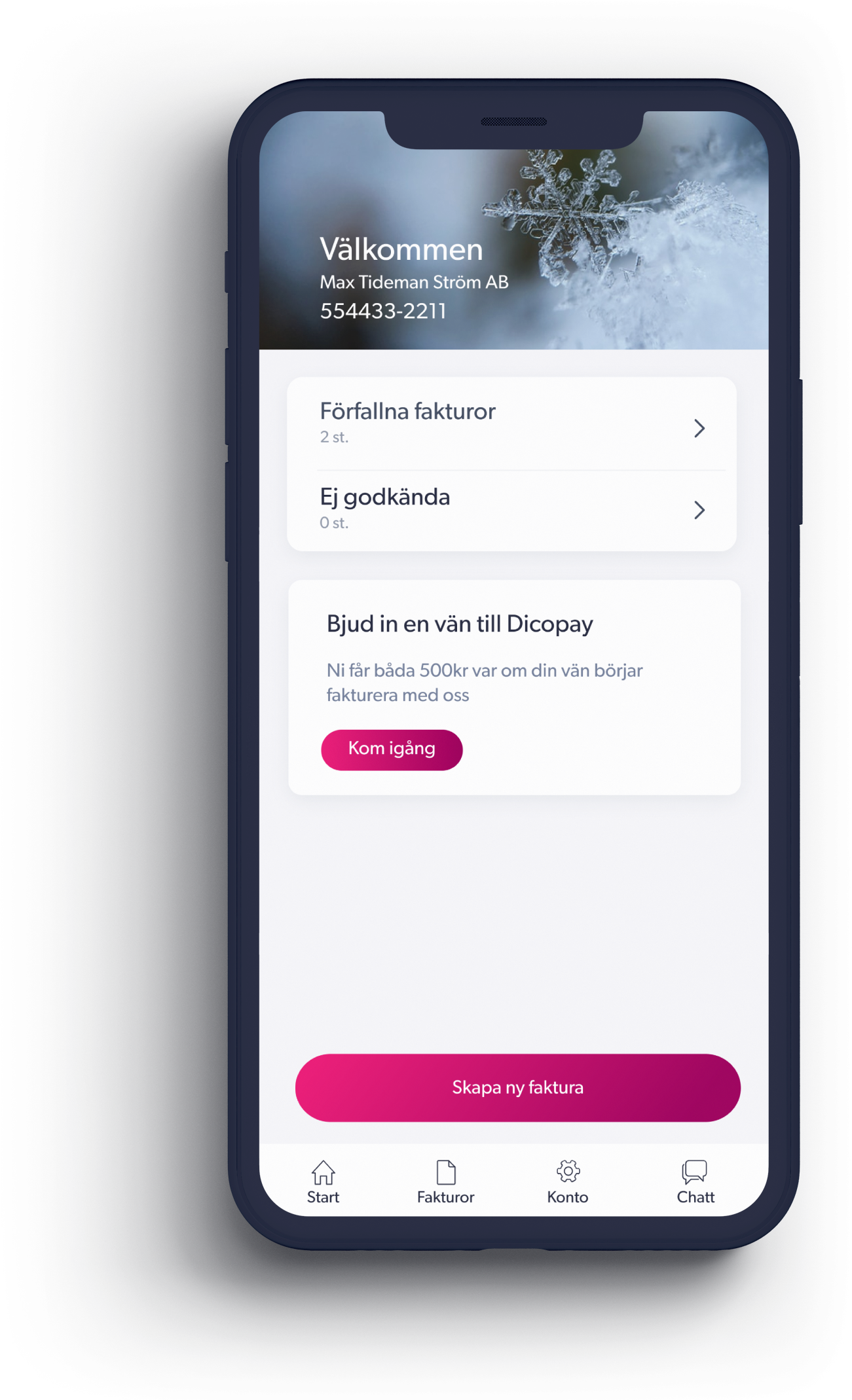
Every application on one screen
Progress billing is a run of invoices against one contract, so the paperwork repeats every month. Send each application as its own invoice, keep the line items consistent with the schedule of values, and see at a glance which ones are approved, which are overdue, and which nobody has opened yet.
Chasing a general contractor's accounts payable desk is a job with no salary attached. It is the part of your week you can hand over first, and it costs nothing to hand over.
Dicopay is not a lender.
Financing is provided by independent regulated lending partners. They decide eligibility, they set the pricing, and they write the terms, and all of it is disclosed to you before you accept. Dicopay is paid a referral fee by the partner when a deal funds, which is how the invoicing stays free. Offers are subject to approval, and not every invoice qualifies.
FAQ
Questions from the jobsite and the office.
My subcontract has a pay-when-paid clause. Can I still finance the invoice?
The clause governs what the general contractor owes you and when. It does not stop you sending the invoice, chasing it, or asking what it is worth today. Whether that invoice qualifies is decided by the funding partner, which looks at the invoice and at the business that owes the money, and your contract terms can affect that decision. Offers are subject to approval and not every invoice qualifies. What happens if the invoice goes unpaid is written on the offer before you accept it: under a recourse arrangement you repay the advance, and where an offer is non-recourse the funding partner carries that risk instead.
Can retainage be financed?
Usually not. Retainage is held back and is not due yet, so it sits differently from the amount approved on this month's application. Eligibility for any invoice is decided by the funding partner and disclosed before you accept. The part of your billing that is approved and payable now is the part worth checking first.
Does my general contractor have to do anything differently?
No. Your customer receives the same invoice, on the same terms, with the same due date. There are no new payment instructions, no new bank details, and no debt collector. The only change they notice is that payment reminders come from Dicopay on your behalf rather than from you.
Which of my invoices can be financed?
Financing applies to invoices issued to another business or a public body, so billings to a general contractor, a developer, or a public works agency are the relevant ones. An invoice to a homeowner on a residential remodel can still be sent, tracked, and chased for free.
Easy invoicing, fast cash.
Send this month's application for free and see what it is worth today. If the number is not worth it, close the tab. You keep the free invoicing and somebody else chasing the general contractor.
Start invoicing for free No card. No subscription. No long-term contract. No obligation to accept an offer.